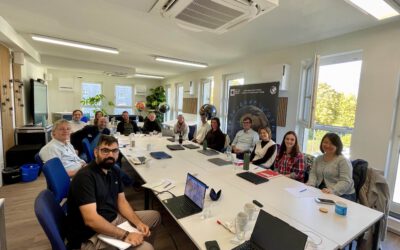

Workshop Report at the Department of Remote Sensing – April 11, 2018

Workshop Report at the Department of Remote Sensing – April 11, 2018

m

March 27, 2018

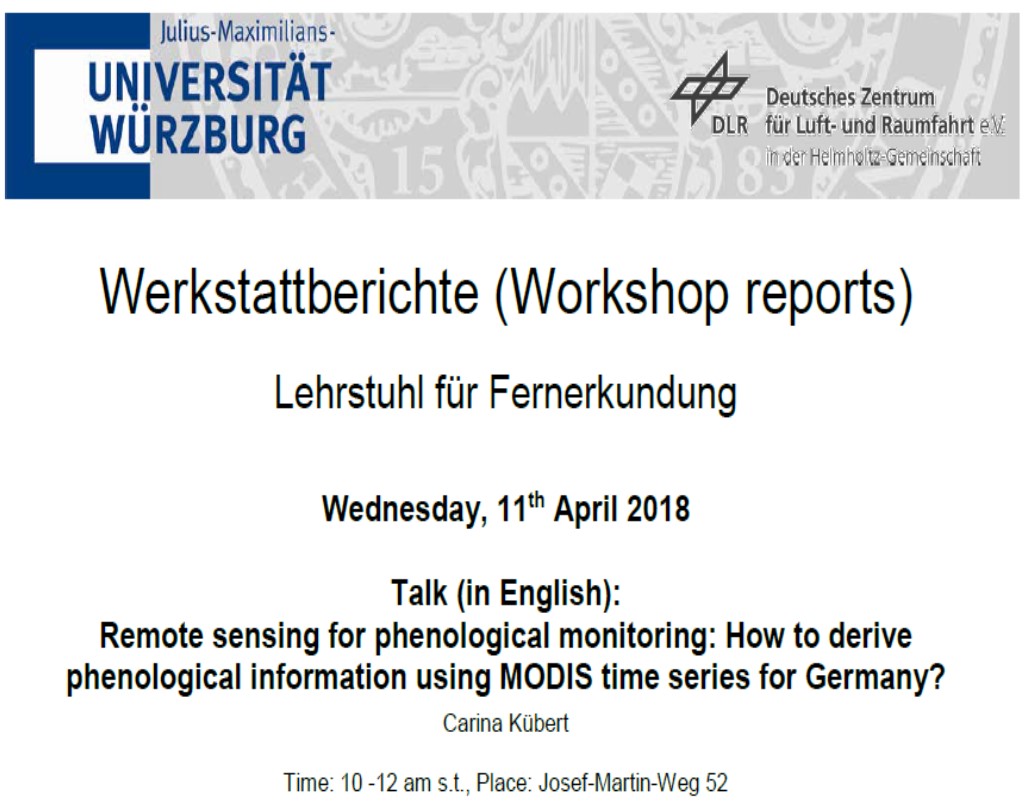
Remote sensing for phenological monitoring: How to derive phenological information using MODIS time series for Germany?

On April 11, 2018, our colleague Carina Kübert will address different questions on how to derive phenological information from time series analysis using MODIS data.

Abstract

“Phenology is perhaps the simplest process for changing the ecology of species as a response to climate change.” (Rosenzweig et al. 2007)

There are several approaches to track phenology in the context of global change. Land Surface Phenology (LSP) deals with methods to monitor vegetation phenology using time series data from Earth Observation satellites. Getting deeper into this topic, it becomes clear that it is not as simple as stated by Rosenzweig et al.: Which data should I use? Which method should I apply concerning filtering, which for outlier detection, which for deriving phenological metrics? What is the meaning of those metrics in an ecological point of view? This talk will give an overview of the modeling framework that helps answering those questions and will give recommendations on how to derive LSP for Germany.

Title of presentation: Remote sensing for phenological monitoring: How to derive phenological information using MODIS time series for Germany?

Presenter: Carina Kübert

Date: Wednesday, 11th April 2018 Time: 10 – 12 am s.t. Place: Josef-Martin-Weg 52, Campus Hubland Nord


All interested persons are cordially invited!


What are the workshop reports about? Presentation of ongoing PhD studies and projects, as well as new modules for the scientific exchange but also for preparation to presenting at conferences. Topics presented will be discussed in an environment of different expertise.

follow us and share it on:

you may also like:

Advancing Agriculture with UAS Multi-Sensor Research

Advancing Agriculture with UAS Multi-Sensor Research

Understanding how agriculture can adapt to a changing climate is one of the key challenges of our time. At EORC, we are pleased to share that our researchers are currently collaborating with the Bavarian State Research Center for Agriculture (LfL) on an innovative...

New roll-up shows Urban Collaboration and Research

New roll-up shows Urban Collaboration and Research

Remote sensing thrives on collaboration as shown (by a few selected ones) on our most recent roll-up. Many of today’s most pressing urban and environmental challenges—rapid urbanization, climate change, landcover change, migration, inequality, and economic...

Hackathon within the Super-Test-Site Project

Hackathon within the Super-Test-Site Project

What happens when researchers and developers sit down together to explore a multidisciplinary urban dataset? Our researchers from the EORC joined a hackathon that took place within the Super-Test-Site Project, organised by Prof. Dr. Gunther Gust from the Chair of...

Field Days in the Oberpfalz: Exploring FSME Hotspots

Field Days in the Oberpfalz: Exploring FSME Hotspots

On April 17th and 29th our researchers Sofía and Ariane had two field days in the areas around Amberg and Schwandorf, one of Germany's most well-known TBE (tick-borne encephalitis) risk regions. They joined Prof. Dr. Gerhard Dobler and Dr. Lidia Chitimia-Dobler from...

Johannes Mast has successfully defended his PhD Thesis

Johannes Mast has successfully defended his PhD Thesis

Johannes Mast defended his PhD Thesis titled "Geographical Migration Research using Remote Sensing and Social Media Data" at the Julius-Maximilians-University Würzburg successfully on the 29th of April 2026. We congratulate him very much for his...

Share This