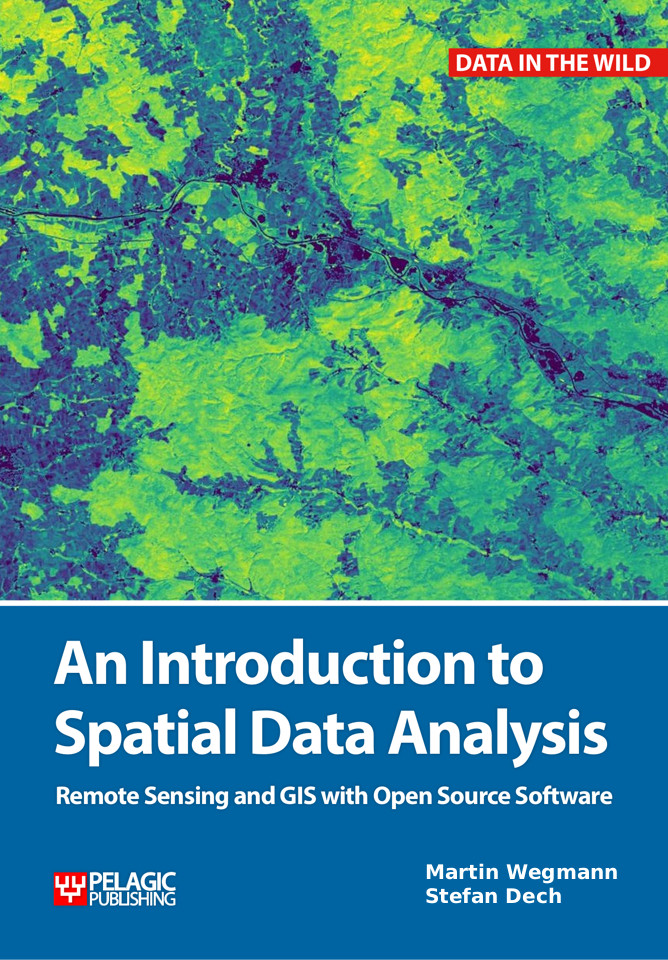

upcoming book: Getting Started with Spatial Data Analysis using Open Source Software

upcoming book: Getting Started with Spatial Data Analysis using Open Source Software

April 27, 2018

A new textbook for students or professionals interested in learning to work with spatial data is currently prepared and will be handed in at the end of this year. It clearly aims at novice users in contrast to the already published book “Remote Sensing and GIS for Ecologist“, which is expecting a sound working knowledge in R and spatial data.

This new book will start much earlier and guide new users of spatial data through the whole process of data collection, data preparation and analysis including making maps, working with GPS and the interaction with a GIS. The book will mainly explain all working steps using QGIS but will also introduce R coding to allow a smooth transitions to the intermediate level textbook “Remote Sensing and GIS for Ecologists”.

Updates on the progress of this book and content, as well as (at a later stage) reviews and data to redo the analysis will be provided on this webpage: http://book.ecosens.org

follow us and share it on:

you may also like:

Thermal Drone Data Acquisitions: CalVal project with Informatics

Thermal Drone Data Acquisitions: CalVal project with Informatics

Thermal cameras on drones look very good - visually. They show us temperature of our study objects be it stressed trees, warm patches in a city or active fires. But we do not yet know for sure how far we can trust the temperature values they deliver especially when...

Würzburger Förderpreis awarded to our URBAN:Pulse project

Würzburger Förderpreis awarded to our URBAN:Pulse project

“A remote sensing scientist, a social geographer, an informatics researcher, a sports researcher, a psychologist, a linguist and an economist meet ... what sounds like the start of a joke, was the start of a great interdisciplinary research project.” That’s how Hannes...

Annual Meeting of the NetCDA consortium

Annual Meeting of the NetCDA consortium

On November 3-4, 2026, the NetCDA II (European Academic Network for Capacity Development in Climate Change Adaptions in Africa) project network of 12 German academic partners met at the EORC for their annual meeting. We welcomed our new German research institutions on...

bzgl. Art. 50 Verordnung (EU) 2024/1689 (AI Act):

Überwiegend werden eigene originäre Texte und Bilder des EORC genutzt, jedoch sind einige Inhalte von blog post Texten teilweise mit Hilfe von KI überarbeitet worden und einige Bilder sind ganz mit KI erstellt, die jedoch deutlich keine photorealistische Darstellungen abbilden. Aussnahmen sind KI generierte fernerkundliche Datensätze, die explizit für Forschungszwecke mit KI erstellt wurden, hier wird aber durch den assoziierten Text der wissenschaftliche Grund der KI generierten Bilder erläutert.

Share This