
Successful sessions and talks at ESA-LPS

Successful sessions and talks at ESA-LPS

July 18, 2016

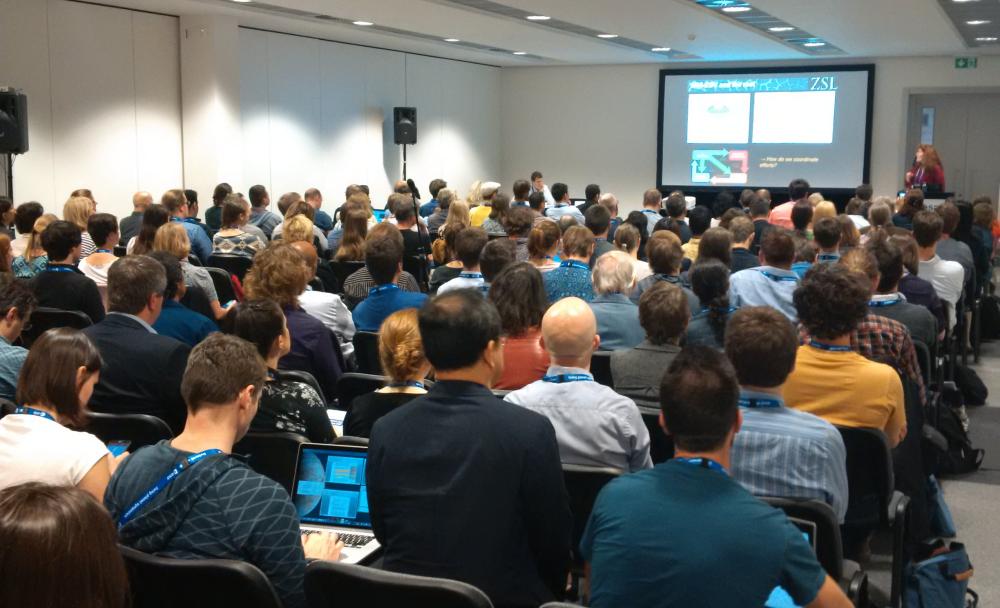
Biodiversity session at ESA LPS n Prague 2016

Biodiversity session at ESA LPS n Prague 2016

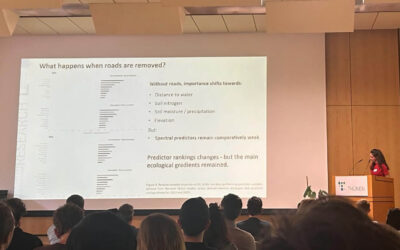
The biodiversity and conservation sessions at the ESA Living Planet Symposium was a huge success. We had a full room with highly interested audience and very fruitful discussions about how remote sensing can help to understand biodiversity patterns as well as the road ahead with Remote Sensing Essential Biodiversity Variables (RS-EBVs). The sessions were organized by Marc Paganini, Gary Geller, Michael Schaepman, Nathalie Pettorelli and Martin Wegmann.

From our department did Ruben Remelgado present his work on remotely sensed environmental variables and their explanatory power for animal movement patterns and Martin Wegmann presented the theoretical and strategic background as well as a variety of achievements how remote sensing can successfully be implemented in ecology and conservation.

We are looking forward to the next ESA-LPS with again highly interesting talks within biodiversity, ecology and conservation sessions.

follow us and share it on:

you may also like:

Remote sensing insights into biogas flowering mixtures

Remote sensing insights into biogas flowering mixtures

Perennial wildflower mixtures are gaining importance as an alternative to maize in biogas production. As highlighted in the praxis-agrar article on crop diversification with biogas flowering mixtures, they combine agricultural use with clear ecological benefits....

PhD submitted by Julia Rieder

PhD submitted by Julia Rieder

We are pleased to share that our PhD student Julia Rieder has successfully submitted her doctoral thesis! Her dissertation, entitled “Abiotic and biotic drivers of drought responses in European beech (Fagus sylvatica L.) inferred from field and LiDAR data”,...

New Funded Project on Automated Detection of Mining Areas

New Funded Project on Automated Detection of Mining Areas

In a newly launched research project funded by the KSB Foundation, we focus on the automated identification of mining areas based on remote sensing data. The aim is to systematically detect large-scale mining activities and to track their spatial and temporal...

Share This