
Prof. Dr. Viktor A. Dukhovniy is the Director of the Scientific Information Center of the Interstate Commission on Water Coordination in Central Asia (SIC ICWC) in Tashkent (Uzbekistan). He is a noted expert and active water specialist in Central Asia with long experiences from his memberships and leads in water partnerships (Interstate Coordination of Water Commission, the International Fund for Aral Sea Saving, Global water Partnership of Central Asia and Caucasus, International Commission on Irrigation and Drainage in the World Water Council, and in the International Water Resources Association). He published more than 350 articles and 22 monographs and prepared 18 PhD students on the water management, advance irrigated agriculture, and perspective planning of water development. He worked in Central Asia, but also as consultant in India, Nicaragua, Syria, Yemen and other states. (http://amudaryabasin.net)
Within the framework of a CAWa/WP3 workshop in November 2016 hosted by the Department of Remote Sensing, Prof. Dr. Dukhovniy V.A. will give a public lecture for the geographical colloquium of the Institute of Geography and Geology at the University of Würzburg.
22 th November 2016
Viktor A. Dukhovniy, PhD, Director of SIC-ICWC (Tashkent, Uzbekistan)
“Water and Land Management in Central Asia – Present Situation and Future Perspective”
04:00 p.m. (16:00 Uhr) c.t., lecture hall HS222
Abstract
Water and Land Management in Central Asia – Present Situation and Future Perspective
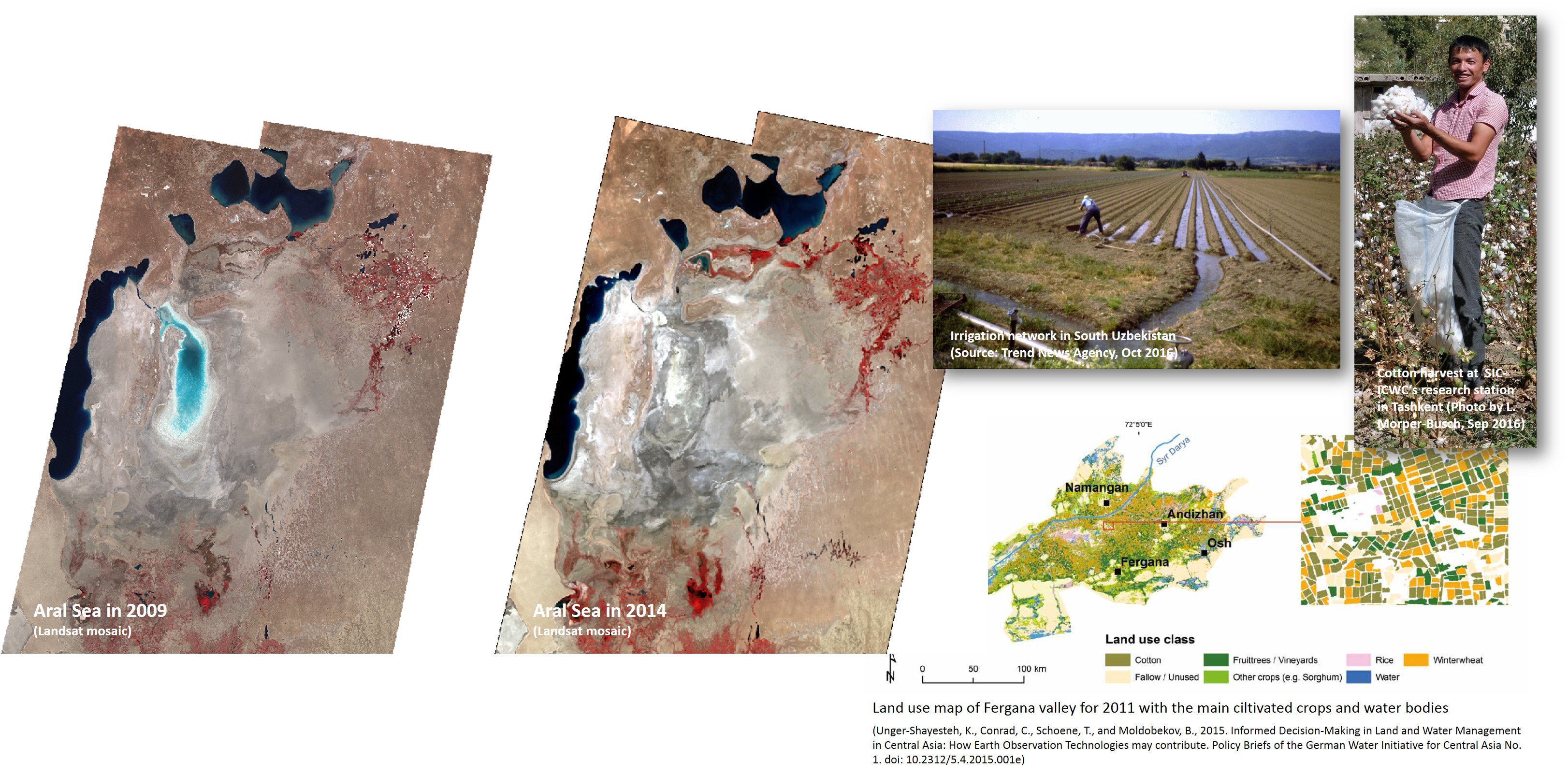
Its location in the semi-arid and arid climate zones is the major reason for the increased dependency of the economic sector, particularly agriculture in Central Asia (Kazakhstan, Kyrgyzstan, Tajikistan, Turkmenistan, Uzbekistan) from the development of land and water use and the access to those resources. Concurrent analysis of demographic pressure and land/water availability underscores a strong geographical discrepancy between the distribution of land and water resources and the socio-economic conditions in many places. Subsequently, the different types of pressure cause a wide range of site-specific management of the land and water resources. As a result, indicators on the productivity of croplands and of water use vary extensively among the provinces in the Aral Sea Basin. However, the main priority of land/water use for all Central Asian countries is food security. During the last years Uzbekistan and Turkmenistan achieved this status by self-sufficiency, in Kazakhstan – by wheat exports and big financial and economic potential. On the contrary, the development in Kyrgyzstan and Tajikistan is yet delayed. The perspectives are narrowly depending on the permanent growth of yields and accordingly the volume of all agrarian productions in the entire region. With regard to the high pressure on the resources, also site-specific solutions for improved land and water management are urgently required. Main directions of present land management comprise:
- Getting control of the land reclamation situation (combat salinity and water logging) by developing and supporting dense networks for drainage water (open, close, vertical, and combined drainage) and by using salt resistant crops;
- Pushing back desertification, at first by afforestation and improved land use planning;
- Spreading advanced technology in irrigation such as drip irrigation or irrigation by using plastic tubes and flumes (increase water use efficiency);
- Searching for optimal crop pattern including an improved selection of second crops.
Present water management in the region has an enormous potential for water saving and for the reduction and control of unproductive water losses. The scope to which water can be saved through proper management was demonstrated by the work of the Scientific Information Center of the Interstate Commission on Water Coordination (SIC-ICWC) in cooperation with the International Water Management Institute (IWMI) and the Swiss Agency for Development and Cooperation (SDC) in the multiyear project on water management in the Fergana Valley. There, thanks to the implementation of 7 principles of Integrated Water Resource Management (IWRM), water delivery could be reduced by 20-25 % without losses of yields. The outcome of 130,000 ha of cropland could be increased by 25-30 %. Another big potential for such success stories can be seen in the simultaneous establishment of land consulting services and Water User Associations (WUAs). The water accounting, especially implementation of the SCADA (Supervisory Control and Data Gathering) system plays a prominent and important role in the context of IWRM and agricultural extension services plays. Despite these potential advances of resource use on the local and landscape scales, the first priority in water management in Central Asia consists in a permanent attention and in a development of a mutual system for interstate management on the base of improved transboundary water performance.