
New RapidEye datasets granted from RESA platform of DLR/Black Bridge

New RapidEye datasets granted from RESA platform of DLR/Black Bridge

October 21, 2015

The Dept. of Remote Sensing recently applied for a time series of 12 RapidEye scenes to support a PhD thesis by Siddhartha Khare (Indian Institute of Technology Roorkee, India). The proposal is now accepted, and th PhD work will be supported by a dense time series of RapidEye scenes acquired in 2013 over dry forests in Lesser Himalayan region of India.

The PhD thesis which will use these processed datasets is entitled  “Object Based approaches for remote sensing-assisted assessment of forest biodiversity focusing on invasive species”, supervised and advised by Prof. S.K. Ghosh (IIT Roorkee) and Dr. Hooman Latifi (University of Würzburg). Additional multisource datasets to be used within the work include time series of Landsat 8 data and Cartosat 2-derived terrain model.

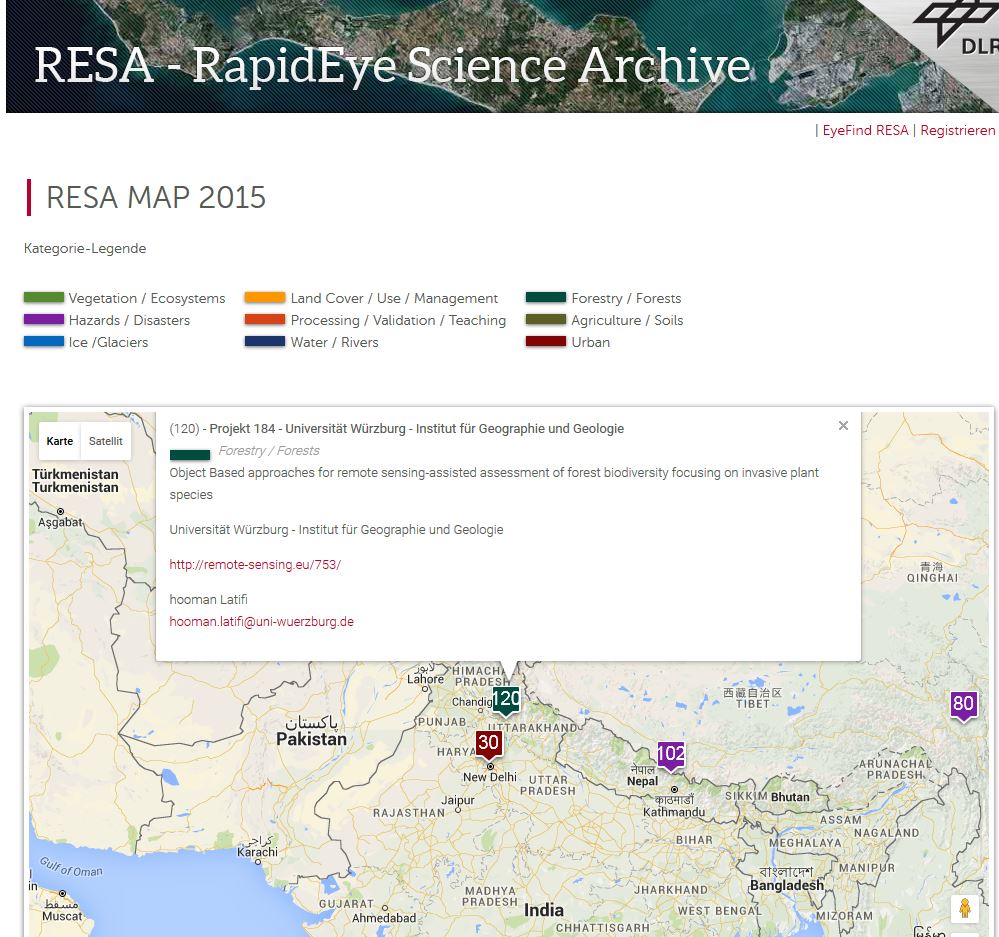
RESA already published this project in RESA project map 2015 which can be found online HERE. The project area is flagged under No. 120 (project number 184) in the map.
resa_india

follow us and share it on:

you may also like:

Preparations in full swing

Preparations in full swing

The countdown is on. With our combined 25th anniversary of EORC and 10th anniversary of EAGLE just around the corner, the whole cluster has been buzzing with preparation. And we mean the whole cluster, staff and students alike have been pitching in on everything from...

ANOTHER REPLY TO THE PROGRAMMING HERO SYNDROME

ANOTHER REPLY TO THE PROGRAMMING HERO SYNDROME

In the Programming Hero post, a lot of us (EAGLE students) recognized ourselves, at least in the situations around it. Since the other perspective usually goes unseen and underestimated, it's time the Silent Hero got a word in too, and explained why this isn't about...

In the News: Monid Habitrack Featured in Süddeutsche Zeitung

In the News: Monid Habitrack Featured in Süddeutsche Zeitung

Süddeutsche Zeitung recently covered our Monid Habitrack project, and we're happy to share it. The article follows the research team at work in the Oberpfalz, where our drones map vegetation and surface temperature while ticks are collected on the ground and tested...

Share This