
New publication: vegetation response to environmental variables in the mountainous forests of Western Himalaya

New publication: vegetation response to environmental variables in the mountainous forests of Western Himalaya

May 23, 2017

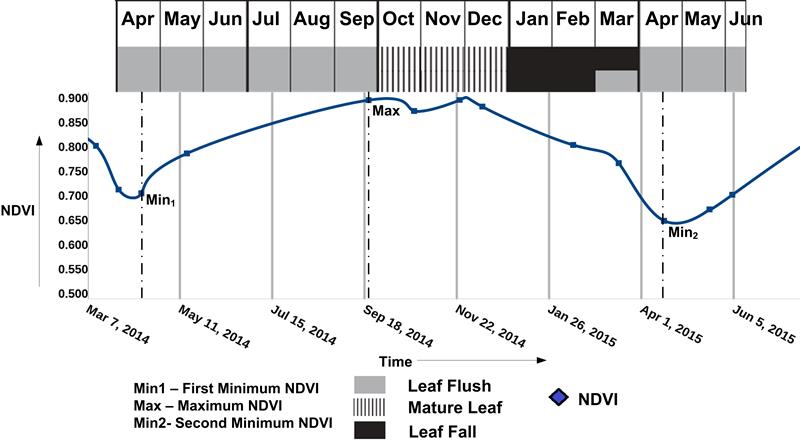
A recently published paper featuring Hooman Latifi and Thorsten Dahms from Dept. of Remote Sensing presents novel results on phenological behaviour of the moist deciduous forests Hymalayan foothills in India during 2013–2015 using Landsat 8 time series data. The paper has been published in International Journal of Remote Sensing, and additionally suggests a new vegetation index called the temporal normalized phenology index (TNPI) to quantify the change in trajectories of Landsat 8 OLIderived normalized difference vegetation index (NDVI) during two time steps of the vegetation growth cycle.
 

Mean NDVI values from April 2014 to June 2015 plotted for study site along with SAL tree
phenology.


Based on cross-validated statistics the paper concludes that  TNPI is a superior alternative for the analysis of temporal phenology cycle between two time steps of maximum and minimum vegetation growth periods. This could, in turn, reduce the requirement of large time-series remote-sensing data sets for studies on long-term vegetation phenology. The paper can be retrieved here.

Bibliography:

Khare, S., Ghosh, S.K., Latifi, H., Vijay,S., Dahms,T. 2017. Seasonal-based analysis of vegetation response to environmental variables in the mountainous forests of Western Himalaya using Landsat 8 data. International Journal of Remote Sensing 38(15), 4418-4442.

follow us and share it on:

you may also like:

New paper on Urban tree classification

New paper on Urban tree classification

Urban tree classification is still a challenge for remote sensing, particularly in heterogeneous urban environments where tree genera are highly diverse and existing inventories often provide incomplete coverage. In our new study, we explore the potential of very...

New research paper on Rapid Urbanization due to the Cobalt Magnet

New research paper on Rapid Urbanization due to the Cobalt Magnet

The Cobalt Magnet: Rapid Urbanization and MigrationAn incredible amount of the technology we rely on every day – from smartphones to lithium-ion batteries in electric vehicles – depends heavily on one single metal: cobalt. With more than 60% of the world's...

Johannes Mast wins Bernd Rendel Prize

Johannes Mast wins Bernd Rendel Prize

Johannes Mast is awarded the 2026 Bernd Rendel Prize for Geosciences by the Deutsche Forschungsgemeinschaft (DFG) for outstanding research as part of his dissertation. Johannes’s highly interdisciplinary work bridges the Geosciences, Linguistics, Data Science, and...

New Technical publication on Regional Planning Smart Solution

New Technical publication on Regional Planning Smart Solution

Urban and regional planning increasingly relies on geospatial technologies to support evidence-based decision-making. Within the European research project FUTURAL – Empowering the Future of Rural Regions, researchers at the Earth Observation Center (EOC) of the...

Share This