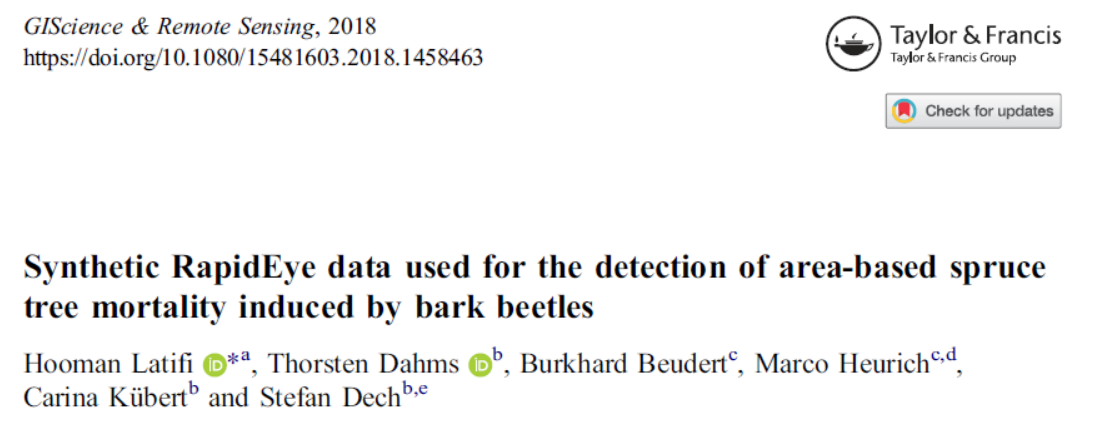

The article “Synthetic RapidEye data used for the detection of area-based spruce tree mortality induced by bark beetles” lead by our former colleague Dr. Hooman Latifi deals with fusing RapidEye and MODIS data to derive dense NDVI time series to detect spruce tree mortality caused by bark beetle infections in the Bavarian Forest National Park. Following a phenology-based approach, we found that spectral information after the peak of the growing season (here 2011) can be used to recognize infestation in the subsequent year (2012).
Funded by a research grant of the Faculty of Philosophy, University of Würzburg, two students gained insight to early-career research. The research was carried out by the support of the Data Pool Initiative for the Bohemian Forest Ecosystem and colleagues from the Bavarian Forest National Park and the University of Freiburg using data of the RapidEye Science Archive and MODIS products provided by the USGS and NASA.