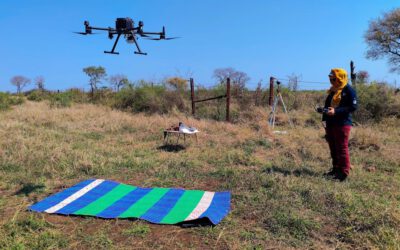

 Mah Coulibaly, a WASCAL PhD student on Climate Change and Land Use at the KNUST in Kumasi (Ghana), is visiting us for three month from May to July. Her PhD topic is about the estimation of above ground biomass and carbon dioxid emissions in the Savanna of Northern Ghana – Upper East Region. During her three month stay in Würzburg she aims to finalize the Remote Sensing analysis where Mah will try to find out how to model her field measures with Remote Sensing indeces like NDVI. She will apply Landsat data to be able to get historical information.
Mah holds a MSc degrees on Geography Management from the University of Bamako (Mali) and on Environment and Sustainable Development from University of Cocody (Côte d’Ivoire). Since March 2016 she joint the WASCAL program on Climate Change and Land Use. We met Mah in Kumasi during our lectures on “Remote Sensing and GIS” and “Advanced Remote Sensing”, where we agreed to work together.