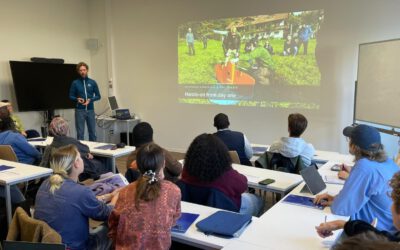

 Chiara Paniccia, a PhD student from University of Molise, is visiting our department from April to August. Chiara is a mammalogist and ecologist, with main interests in conservation biology, spatial ecology, and community ecology. She obtained a Master’s Degree in Natural Sciences at ‘Sapienza’ University of Rome in 2014 with a thesis on the effect of forest management practices on arboreal rodent populations in the Central Apennines. Currently, she is a Ph.D. student at University of Molise, Italy.
Her Ph.D. project aims to investigate how ecological patterns and animal communities are modified by human activities or respond to land-cover modifications in space and time.She is using different methods to answer theoretical and applied questions in quantitative ecology and conservation topics, with a focus on applicative and management aspects.
From 1st April to the end of August 2018 she will be a visiting student at our department. Within these five months she likes to perform a community ecology analysis based on land-cover changes in central Italy in a 30-years period. She wants to explore and improve the technical aspects of landscape pattern and time-series analysis.
Further details about her education:
- October 2017 to March 2018 – Visiting scholar at Fondazione Edmund Mach and University of Trento (Italy). Supervisor: Prof. Duccio Rocchini.
- 2015-ongoing – Ph.D. student at University of Molise, Dep. Biosciences and Territory.
Thesis: “Small mammals in a changing landscape: monitor communities from local to broad scales”. Supervisor: Prof. Anna Loy and Prof. Marco Marchetti.
- 2014 – Master degree in Natural Sciences “Nature conservation”, Sapienza University in Rome. Thesis: ”Influence of forest management practices on the relative abundance of arboreal rodents in Central Apennines”. Supervisors: Prof. Anna Loy (University of Molise) and Dr. Carlo Rondinini (Sapienza University, Rome).