MSc thesis handed in on Analysis of Airborne LiDAR Data for Deriving Terrain and Surface Models

MSc thesis handed in on Analysis of Airborne LiDAR Data for Deriving Terrain and Surface Models

May 9, 2016

A M.Sc thesis by Raja Ram Aryal  at the University of Applied Sciences Stuttgart was recently written  under the supervision of Dr. Hooman Latifi and Prof. Michael Hahn. The thesis focused on a comparative study on the variations of an adaptive TIN ground filtering algorithm  to extract DTM from discrete LiDAR point cloud captured in leaf-off and full wave LiDAR point cloud collected in leaf-on conditions. In addition Analysis of Variance (ANOVA) type II was used to assess the influential factors that are related to DTM random error.  The Accuracy assessment of extracted DTMs was done  at local and landscape levels in heterogeneous forest stands of Bavarian Forest National Park. The DTM generated using mirror points in leaf-off returned less RMSE (0.844 m) than in leaf-on (0.988 m) conditions. Furthermore RMSE values of 0.916 m (leaf-off) and 1.078 m (leaf-on) were observed the local level analysis when no mirror points were used. However, RMSE value of ca. 0.5 m was observed at the landscape level, with leaf-off DTM showing slightly higher error than leaf-on DTM. The DTM error increased with increasing slope. Deciduous habitat was found to significantly influence DTM error in both leaf-off and leaf-on conditions. Interaction effects were mainly observed between slope and forest habitat type.
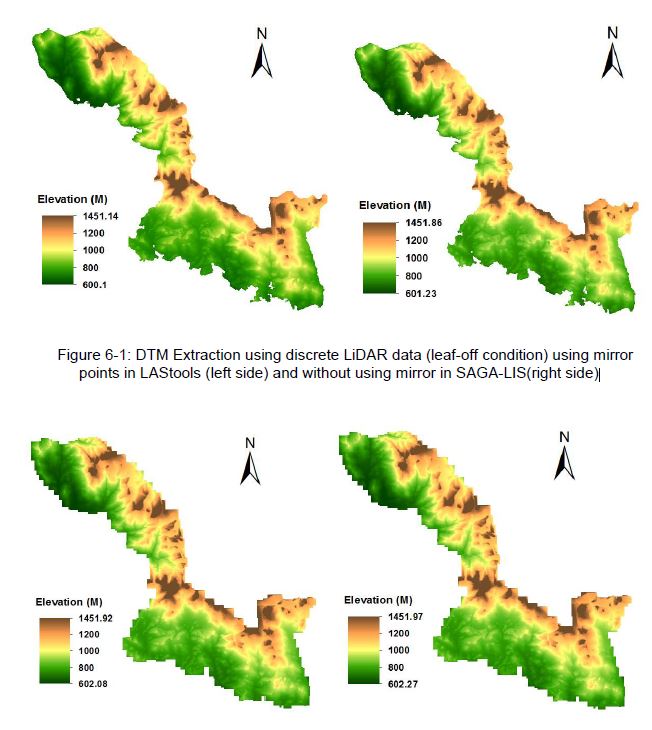
DTMs Extracted using denser point cloud LiDAR data (leaf-on condition) using mirror points  (left side) and without using mirror (right side)

DTMs Extracted using denser point cloud LiDAR data (leaf-on condition) using mirror points (left side) and without using mirror (right side)

follow us and share it on:

you may also like:

From Data to Impact: Viktoria Veith’s Internship at WWF

From Data to Impact: Viktoria Veith’s Internship at WWF

Understanding the environmental consequences of conflict is one of the most pressing challenges in contemporary Earth observation. During her internship at WWF, EAGLE MSc student Viktoria Veith has been working at the intersection of remote sensing, policy, and...

Empowering Biology Students with Open-Source Spatial Data Skills

Empowering Biology Students with Open-Source Spatial Data Skills

At EORC, we believe that spatial thinking and geodata literacy are becoming essential skills across scientific disciplines. This semester, we had the pleasure of contributing to the Biology MSc programs MERGE and other study tracks at the Biology Institute through a...

Farewell to Our Second Cohort of ERASMUS+ Scholars

Farewell to Our Second Cohort of ERASMUS+ Scholars

This winter semester, we had the pleasure of hosting the second cohort of eight ERASMUS+ scholars from Ghana, Rwanda, and South Africa. As their semester at our university comes to an end, we are delighted to celebrate their achievements and bid them a warm farewell....

EAGLE Students in Kruger National Park: Internship at SANParks

EAGLE Students in Kruger National Park: Internship at SANParks

EAGLE MSc students Sebastian Rothaug and Clemens Schömig are currently completing an internship/InnoLab with SANParks in Kruger National Park, South Africa. During their stay, they are contributing to a project on fire and drought dynamics in savanna ecosystems. Their...

EAGLE M.Sc. Students doing Arctic Internship

EAGLE M.Sc. Students doing Arctic Internship

This spring, Marlene and Aoibhin, two students from our EAGLE M.Sc. program have started their research internship in the high Arctic on Svalbard. Hosted by Prof. Larissa Beumer at the University Centre in Svalbard (UNIS), the students are gaining hands-on experience...

Share This