

LaVaCCA Introductory GIS / R course in Almaty, Kazakhstan

LaVaCCA Introductory GIS / R course in Almaty, Kazakhstan

April 27, 2015

LaVaCCA_Project_Logo

Logo of the LaVaCCA project

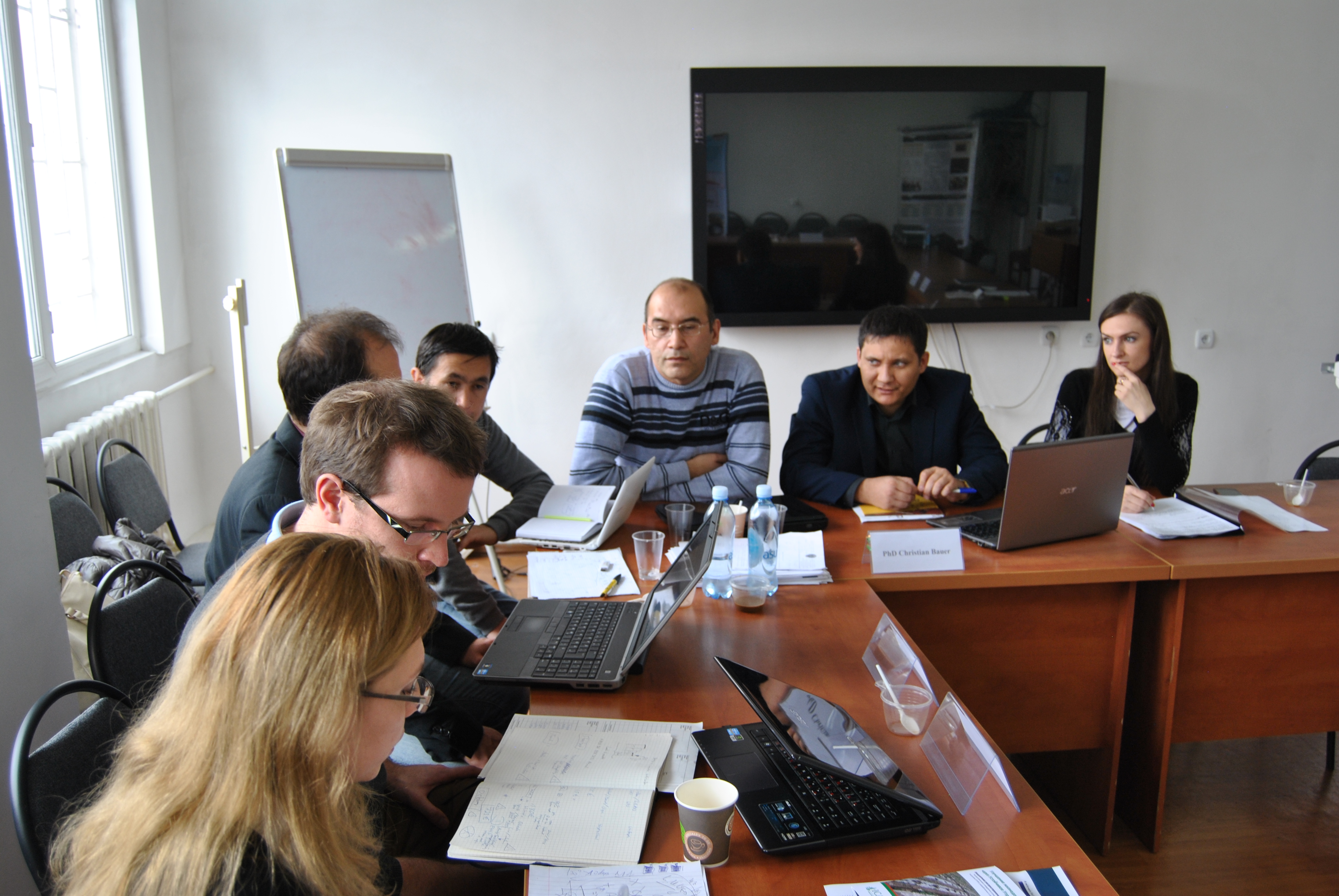
After the kick-off meeting of the Volkswagen Foundation funded LaVaCCA project in Almaty (see post), an intensive R/GIS training was held in the GIS lab of the Al ́Farabi Kazakh National University, organized and led by staffers from the Department of Remote Sensing, Würzburg University. Young scientific staffers, post-docs and PhD students as well as invited guests from SIC-ICWC, Al´Farabi University and CAREC joined the training course from February 12th to 17th 2015.

The focus of the course was on methods and techniques for the application of satellite remote sensing in agricultural management, including the use of the statistical and open source programming language R:


  • Introduction to the statistical software R
  • Spatial statistics in R
  • Working with vector data in R
  • Working with raster data in R
  • Visualizing and manipulating satellite data in R

This course served as a preparatory course for another, intensive training to be held in Urgench, Uzbekistan, in summer 2015. The feedback from the participants for the first course in Almaty was very positive and participants were given the opportunity to propose the topics and schedule of the second course in Urgench, Uzbekistan in summer 2015.

More information on the LaVaCCA project can be found here. Information on the R project for statistical computing, including download links can be found here.
GIS/R_training_LaVaCCA

Participants of the LaVaCCA R/GIS course in Almaty, Kazakhstan


follow us and share it on:

you may also like:

Würzburger Förderpreis awarded to our URBAN:Pulse project

Würzburger Förderpreis awarded to our URBAN:Pulse project

“A remote sensing scientist, a social geographer, an informatics researcher, a sports researcher, a psychologist, a linguist and an economist meet ... what sounds like the start of a joke, was the start of a great interdisciplinary research project.” That’s how Hannes...

Annual Meeting of the NetCDA consortium

Annual Meeting of the NetCDA consortium

On November 3-4, 2026, the NetCDA II (European Academic Network for Capacity Development in Climate Change Adaptions in Africa) project network of 12 German academic partners met at the EORC for their annual meeting. We welcomed our new German research institutions on...

Mainpost reported on Stefan Dech’s Bavarian State Medal

Mainpost reported on Stefan Dech’s Bavarian State Medal

We’re happy to see that Mainpost, our local newspaper, also reported on the Bavarian State Medal for Outstanding Services to the Environment. Stefan Dech received it on October 21 at the Munich Residenz, and Environment Minister Thorsten Glauber gave the laudatory...

UrbanPulse in the Mainpost, and invitation to the festivities

UrbanPulse in the Mainpost, and invitation to the festivities

If you open the printed Mainpost today, keep an eye out for the Universitätsbund Würzburg’s invitation to the Festkonzert. Among the topics on the page, there’s one we’re rather proud of: our newly funded project URBAN:Pulse, which will be officially celebrated at the...

Field work for MONID-HABITRACK project

Field work for MONID-HABITRACK project

Today our researchers from the department working on the MONID-HABITRACK project, that is funded by the BMFTR, went to the field to acquire LiDAR, thermal and multispectral data with their drones. Within our department the project is located at the Chair of Remote...

bzgl. Art. 50 Verordnung (EU) 2024/1689 (AI Act):

Überwiegend werden eigene originäre Texte und Bilder des EORC genutzt, jedoch sind einige Inhalte von blog post Texten teilweise mit Hilfe von KI überarbeitet worden und einige Bilder sind ganz mit KI erstellt, die jedoch deutlich keine photorealistische Darstellungen abbilden. Aussnahmen sind KI generierte fernerkundliche Datensätze, die explizit für Forschungszwecke mit KI erstellt wurden, hier wird aber durch den assoziierten Text der wissenschaftliche Grund der KI generierten Bilder erläutert.

Share This