LASmoons license granted for a M.Sc candidate

LASmoons license granted for a M.Sc candidate

August 20, 2015

Recently, the M.Sc student Bastian Schumann applied for a 3-month sull license of LAStools to be applied in the course of his M.Sc thesis “Explaining over- and understory canopy coved by leaf-off and leaf-on LiDAR data”. LAStools consists of highly efficient, batch-scriptable, multicore command line tools to classify, tile, convert, filter, raster, triangulate, contour, clip, and polygonize LiDAR data. By submitting an appllication supported by a proposal,  limited number of underfunded academics who have no budget for a full academic LAStools license qualify for a few LASmoons of full LAStools functionality. These complimentary licenses typically last three full months.
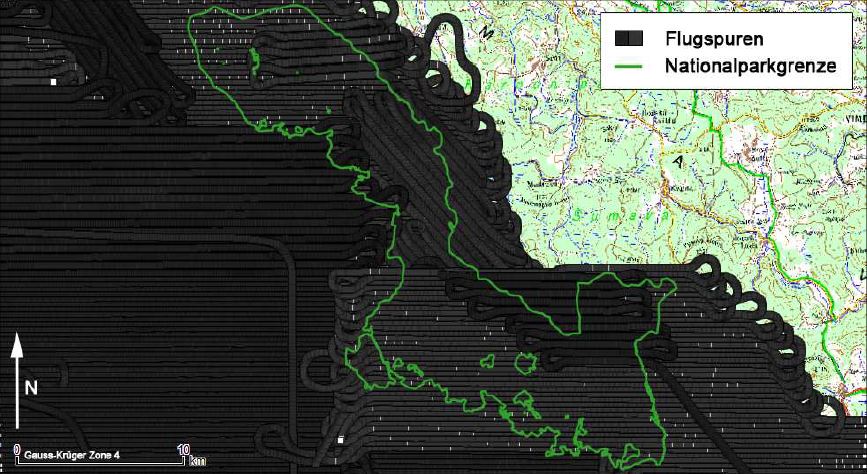
Example of LiDAR flight strips over the entire Bavarian Forest National Park

Example of LiDAR flight strips over the entire Bavarian Forest National Park

Supervised by Dr. Hooman Latifi from Dept. of remote sensing in Würzburg, Bastian Schumann will extract statistical and density metrics from two sets of leaf-off and leaf-on LiDAR data to make an accurate and unbiased estimation of canopy density in tree, shrub and herbal layers within the Bavarian Forest National Park. LAStools will be used here to initially process the raw point cloud data and create DTMs, DSMs and CHMs and to derive LiDAR metrics from normalized LiDAR points. The full version of LAStools is needed to assure timely processing of the vast amount of raw data.The results of this study will be used as a benchmark to compare with those previously achieved by Latifi et al. (2015) using leaf-on data across the same study area.

Further informaiton on this project can be found in the LASmoons blog which will also cover further updates on the opurtcomes of this work.

follow us and share it on:

you may also like:

Hackathon within the Super-Test-Site Project

Hackathon within the Super-Test-Site Project

What happens when researchers and developers sit down together to explore a multidisciplinary urban dataset? Our researchers from the EORC joined a hackathon that took place within the Super-Test-Site Project, organised by Prof. Dr. Gunther Gust from the Chair of...

Field Days in the Oberpfalz: Exploring FSME Hotspots

Field Days in the Oberpfalz: Exploring FSME Hotspots

On April 17th and 29th our researchers Sofía and Ariane had two field days in the areas around Amberg and Schwandorf, one of Germany's most well-known TBE (tick-borne encephalitis) risk regions. They joined Prof. Dr. Gerhard Dobler and Dr. Lidia Chitimia-Dobler from...

Johannes Mast has successfully defended his PhD Thesis

Johannes Mast has successfully defended his PhD Thesis

Johannes Mast defended his PhD Thesis titled "Geographical Migration Research using Remote Sensing and Social Media Data" at the Julius-Maximilians-University Würzburg successfully on the 29th of April 2026. We congratulate him very much for his...

EAGLEs at SANParks – Kruger National Park

EAGLEs at SANParks – Kruger National Park

Our EAGLEs Sebastian Rothaug and Clemens Schömig just finished their 2+ months for the internship/InnoLab in Kruger National Park. The work was done with SANparks, Dr. Coetsee and Dr. Wigley within a year-long collaboration of EORC researcher Dr. Bevanda. The...

Fieldwork in Focus: Our New “Hex Wall” Installation

Fieldwork in Focus: Our New “Hex Wall” Installation

At EORC, the transition from physical reality to digital analysis is a core part of our methodology. While our primary output consists of Earth Observation data the foundation of this work is laid in the field. To document this essential aspect of our research, we...

Share This