CODE-DE – Satellite data free of charge for everyone

CODE-DE – Satellite data free of charge for everyone

March 27, 2017

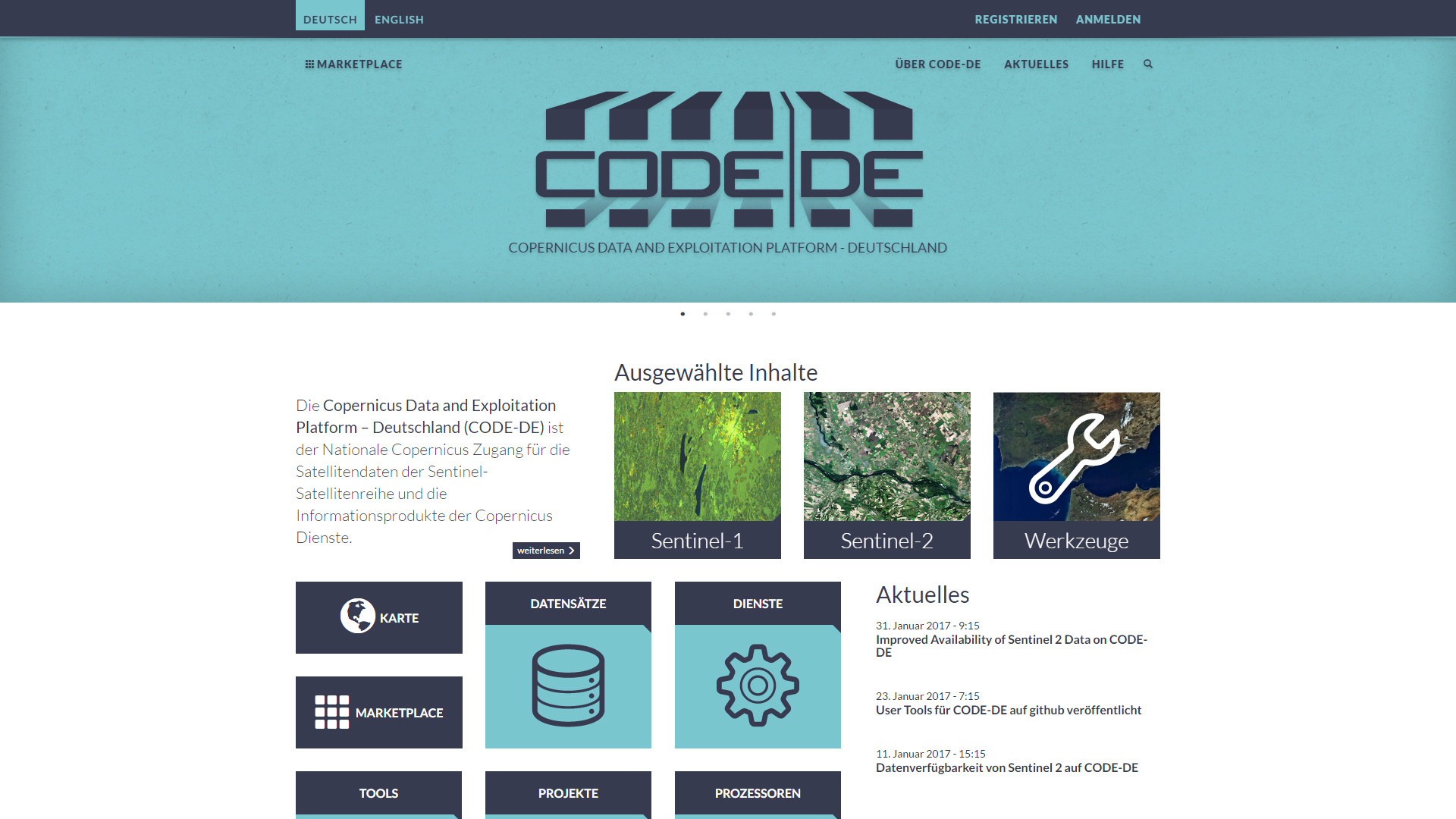
Our colleagues at DLR released a platform which allows easy and free of charge access to Sentinel remote sensing data:

CODE-DE makes possible free-of-charge, simple access to data from the Sentinel satellites and to information products from the European Copernicus programme–including an up-to-date cloud-free mosaic of Germany, produced at EOC. The platform will also provide access to national geodata infrastructure (GDI-DE). This portal provides harmonised and standardised German geodata from a wide variety of sources. By agreement with industrial partners it is also planned to offer data from the German radar satellites TerraSAR-X and TanDEM-X as well as high-resolution optical images from RapidEye satellites.

CODE-DE offers a one-stop shop. The data is collected in a single portal so that users no longer have to search through various databases, as formerly. This gives them direct access to an enormous amount of data—the Sentinel satellites alone will produce a data volume of some 50 petabytes by the end of 2020.


read more: http://www.dlr.de/eoc/en/desktopdefault.aspx/tabid-11932/20674_read-48811/


follow us and share it on:

you may also like:

How We Learned to Fly: The Story Behind UAS Research at EORC

How We Learned to Fly: The Story Behind UAS Research at EORC

Every research group that's ever bought a drone has a story about the first one it lost. We're no different. So let's just get that out of the way up front: this is the inside story of how UAS (Unoccupied Aerial System) research grew up at the Earth Observation...

MainPro workshop on TLS and LiDAR UAS

MainPro workshop on TLS and LiDAR UAS

This week, a workshop organized by Sebastian Buchelt within our EFRE project MainPro brought together students, researchers, and interested project partners to explore modern UAV technologies. The workshop took place in vineyards close to Würzburg and gave the...

25 Years of Remote Sensing in Würzburg

25 Years of Remote Sensing in Würzburg

Our chair of remote sensing, Professor Stefan Dech, likes to say "science is rarely a sprint, it's a marathon". And if you look at what's grown out of Würzburg over the last 25 years, you'll see exactly what he means. In 2026 the Julius-Maximilians-Universität...

Starkregen in Bayern: Beobachtungen und Dokumentation zählen

Starkregen in Bayern: Beobachtungen und Dokumentation zählen

Starkregenereignisse treten immer häufiger lokal, kurzfristig und mit hoher Intensität auf. Innerhalb weniger Stunden können sie erhebliche Überschwemmungen und Schäden verursachen. Um solche Ereignisse künftig besser zu verstehen und die wissenschaftliche Grundlage...

Seeing the World in Points: Lidar Course for the EAGLEs

Seeing the World in Points: Lidar Course for the EAGLEs

Lidar has a funny way of sneaking up on you. You think you know what it is, a laser that measures distance, fine, but then someone shows you a point cloud of a forest canopy with individual branches floating in 3D space and suddenly you realize there's a whole...

TV Crew Films EORC at MONID Habitrack Fieldwork

TV Crew Films EORC at MONID Habitrack Fieldwork

A bit of extra excitement at EORC recently: A television crew showed up to film a segment on the MONID Habitrack project financed by the BMFTR, and Dr. Ariane Droin was right in the middle of it, walking them through what Earth...

Share This